Sunday, June 1, 2014

A few ground covers and some other non-trees

When I began this blog calling it Memphis trees, it did not take long before I realized there were some notable non-trees to mention. I have already done this for a few tree dwelling vines and climbers like poison ivy, Carolina Jessamine and the very large Lady Banks rose and our oakleaf hydrangea. Here I would like to create a space for items like these, without apologies to the tree lovers who come to see trees.

Ground cover #1 English ivy (Hedera helix)

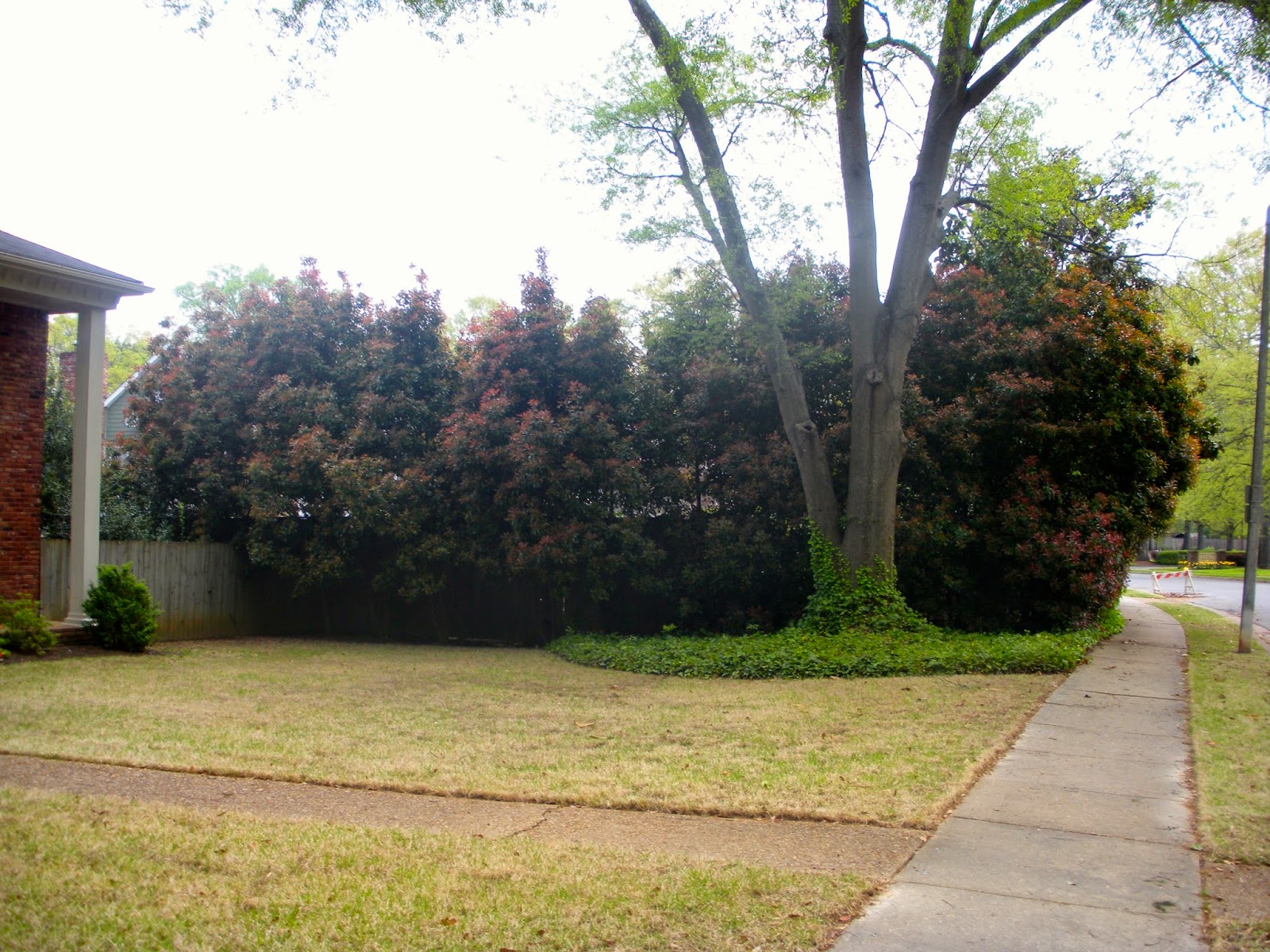
On the corner property at Satinwood Dr. and Hickory Crest May 15, 2014
This ivy can make a beautiful ground cover. It is challenging to remove fallen leaves from the mat of green. In some places like the Pacific Northwest, English ivy or varieties of ivy have been declared a noxious weed, as it can escape from cultivation (rather like kudzu).

Ground cover #2 Pachysandra

 
Pachysandra in the Greentrees neighborhood (on Thornwood) May 18, 2014


Closeup of pachysandra


A gift plant called Grandma's lace, not otherwise identified (April 25, 2014)
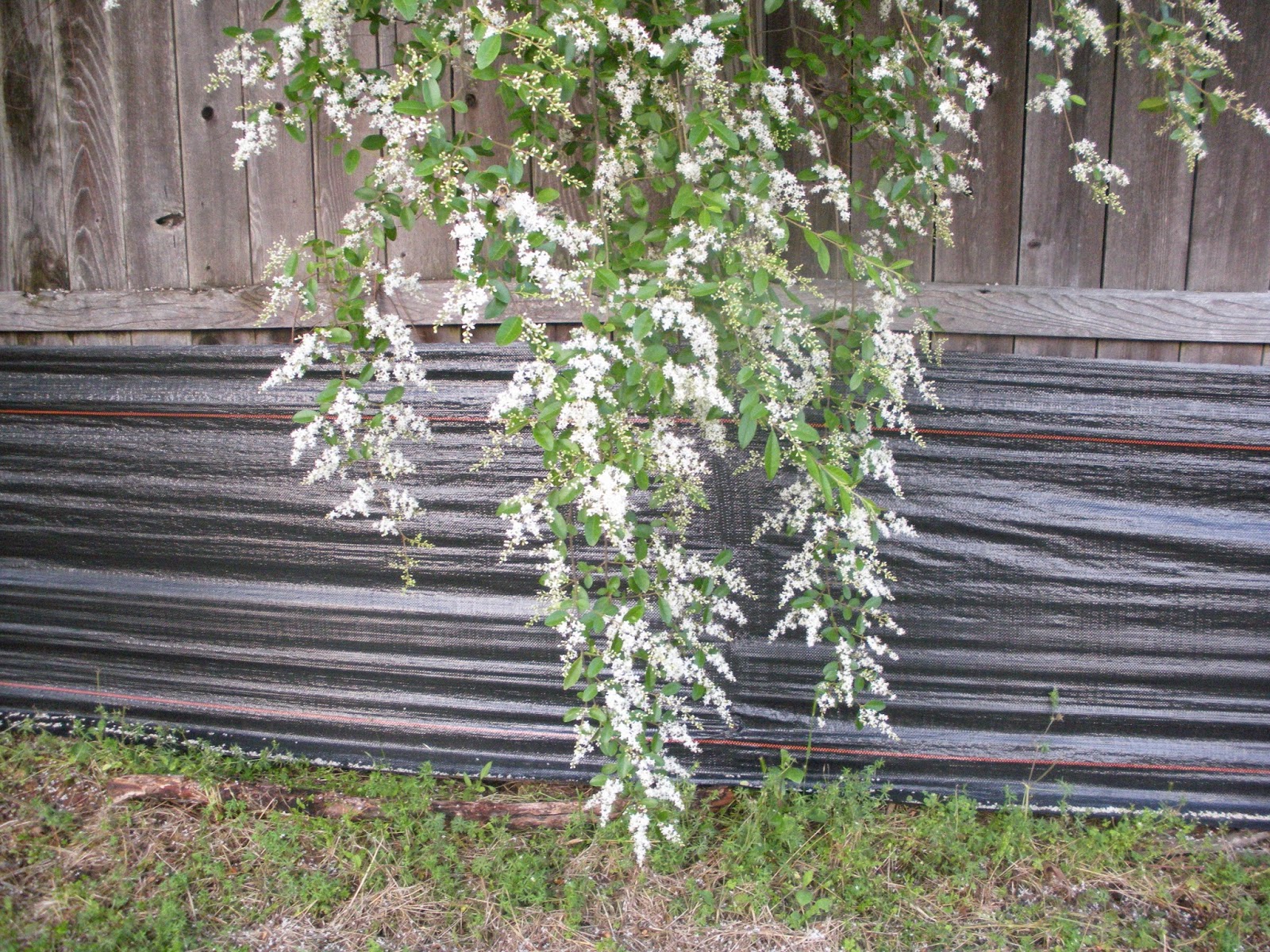
This plant in our front yard was given to us. I do not know what it is. It makes a pretty show in April. Behind it you can see the oakleaf hydrangea featured earlier, (tree #26) before it bloomed.

Vine #5 wild grapes

Jungle-like mix of wild grapevine and mimosa tree, near Holmes Park on Hickory Crest, June 28, 2014
 The mimosa tree is covered by the grape seeking a home in the light.

Rare trees

Tree # 72 Allegheny chinkapin

Some trees are rarely seen in Memphis. I was almost stopped in my tracks last Thursday when driving home by an alternate route due to traffic on Sam Cooper. We came east on Walnut Grove. Just east of LaVerne on the south side there was a novel looking tree in bloom. I had never seen one like it before. Consulting my Audubon Society Field Guide to North American Trees, I concluded it was an Allegheny chinkapin, a member of the beech family. 

Feathery catkins erupt all over this tree May 31, 2014
 Here are some closups of the leaves and flowers.


The trunk of the tree, with deeply furrowed bark (May 31, 2014)
This is clearly not a beech as beeches have smooth gray bark, a favorite surface on which young lovers often carve their initials. The scientific name is Castanea pumila, in the same genus as the American chestnut. American beech trees are a subject for a later entry. There is a trail leading down to the Mississippi River in Meeman-Shelby State Park (just north of Memphis) that passes through a veritable American beech forest. 

Tree #73 Kousa dogwood

At the entrance to Elmwood Cemetery to the right after you cross the old bridge, I found a late blooming dogwood. We talked about dogwoods earlier since they are a spring tree. 

Kousa dogwood at Elmwood Cemetery May 25, 2014

The typical dogwoods Cornus florida are long since finished blooming, while this tree is at its peak in late May. The flowers of Cornus kousa (actually white bracts below the true flowers) appear after the leaves. This is the reverse of Cornus florida, where the flowers come out first. Elmwood Cemetery is simultaneously the
Carlisle S. Page Arboretum, a level II arboretum, so specified in 1997 by the Tennessee Department of Urban Forestry. This and many other trees are labeled, making identification by the viewer unnecessary.

Sunday, May 18, 2014

The Murder of the Regal Privet

This is the time of the year for Regal privet to bloom. The fence across Poplar Pike from Satinwood drive has an abundance of the flowering privet now.

Regal privet May 18, 2014 north of the railroad tracks at Poplar Pike and Satinwood Dr.

Closer view of the same plant
These plants are very showy when in bloom.  I had posted Regal pivet before as tree #17 in the Memphis Trees Continued post, but the plant was not flowering then. 

The two block section of Poplar east of Papa Johns and south of the Jewish Community Center had a solid wall of this privet up to the Carre Four Mall. I was looking forward to seeing this massive hedge in bloom, but this week this is what I saw instead. 

Welcome to Germantown
Just past the Germantown sign the stumps of the privet are in view. The whole two block section of the road is like this as shown in the next few pictures.


The ruined muddy space between the curb and the apartments is like the Desolation of Smaug. At the time I stopped to take these pictures, another man had stopped and got out of his car with a cell phone. He was also taking a picture. I asked him if he was documenting the hedge destruction and he said no. He owns the corner lot and he was trying to sell it so they could put a restaurant there. He wanted a picture of the property. I asked him about the hedge and he thought the City of Germantown did the clear cutting. I does start just past the Welcome to Germantown sign.  

Perhaps they want to put in a sidewalk. 

I can only imagine if this was done by the city of Germantown they must have voted on it in a city council meeting. What possible justification for this destruction could be found in the archives? I wonder.

                                                             RIP

What regal privet can be like

Corner of Shady Grove and Shady Grove Terrace, May 20, 2014
The owners of this corner lot have planted regal privet hedge on both Shady Grove and Shady Grove Terrace, wrapping around the Y intersection in this scenic part of Shady Grove. All together there must be 200 feet of this delightful green wave. The flowers are fading now. They had their prime a few days earlier (see the May 18 picture above of a different plant). The next view is looking down Shady Grove Terrace. This gives the scale of the hedge. The Poplar hedge used to be like this before someone made a decision to rip it out. 

Magnificent regal privet hedge down the length of Shady Grove Terrace


Sunday, May 4, 2014

Eye catching trees

Tree # 20 updated for spring: the Chinaberry tree

There are some days when you are just driving along on some side street (with your camera handy) and you come across an unexpected surprise. Today was such a day. On the way to church with Sara, my friend who needs a ride on Sundays, I stopped to update a picture of the China berry tree posted in the winter [tree #20 Dec. 15, 2013, Trees with unusual pods and berries]. This tree is now leafing out and has some small purple flowers.

China berry tree May 4, 2014 showing last years fruit, new leaves and flowers.
The berries are falling off now and lining the ground.

Pavement under the tree is being peppered with chinaberries May, 4, 2014
Tree #66 Paulownia tomentosa (Empress tree)

Here is the surprise find. Just south on Manassas from the chinaberry tree was an old favorite of mine. This tree is a Paulownia or Empress tree. 


Paulownia tomentosa May, 4, 2014 on the west side of Manassas street at Peach St. (between Poplar and N. Parkway)
The leaves are large and heart shaped and if the tree is pruned the new leaves can be almost one foot across like an elephants ear. The leaves are similar to a catalpa's leaves. However, the catalpa makes long seed pods like bean pods, and this tree does not have those. If you look closely you can see last years seed pods in clusters near the top right corner. The flowers are purple and look like foxglove flowers. I know a place just northwest of Southern and the railway crossing at Goodlett where there is a catalpa. I need to go by there soon and take a picture for comparison (see tree #71 later in this post). 

The Paulownia is a romantic tree as it figures in the beginning of the Tale of Genji. The first chapter is called Kiritsubo (the Arthur Waley 1925 translation), or The Paulownia Court (the Edward Seidensticker 1977 translation). Waley's chapter begins: "At the Court of an Emperor (he lived it matters not when) there was among the many gentlewomen of the Wardrobe and Chamber one, who though she was not of very high rank was favoured far beyond all the rest; so that the great ladies of the Palace, each of whom had secretly hoped that she herself would be chosen, looked with scorn and hatred upon the upstart who had dispelled their dreams." The tree is called Kiri in Japan. The emblem of the Prime Minister's office is go-shichi-no-kiri

 
I discovered The tale of Genji in 1977, just after visiting an exhibition of six and twelve-fold Japanese screens at the Volunteer Park Museum in Seattle. James Michener (author of Hawaii, and other epic novels) had an exhibition of Japanese woodblock prints on display and the screens were in conjunction with that exhibition. One of the screens illustrated scenes from the Tale of Genji. Later, that week, quite by accident, I was in the University of Washington Bookstore and I came across the new Seidensticker translation. It was in a lavish box set with beautiful detail from a screen depicting a garden with rushes and quite possibly flowers resembling Chinese privet shown later in this post. I had to have it. I spent the summer reading it in Alaska in my first year after graduation from college. Now I have several translations of the multi-volume thousand page book (originally a scroll). The art library at the University of Washington has a fabulous illustrated reproduction of a real scroll. This is in a large box covered with lavender taffeta and closed with ivory pins. The pages show the original text in ancient Japanese hand painted over gold leaf and lavishly illustrated. Even for one who cannot read the old text (even modern Japanese cannot read ancient Japanese) it is a treasure to view. The price was a bit out of my range ($400).

The Empress tree was named for an empress, but not a Japanese empress. The tree was named for Anna Pavlovna, the daughter of Czar Paul I of Russia. She married William II of the Netherlands. This family was a patron of botanical collectors and that is how the empress tree was named. 


Closer view of the Paulownia flowers and some seed pods are also visible.
The University of Washington Arboretum has one of these trees near the entrance. You actually have to walk past it from the parking lot. I did not think it was in Memphis, so I was glad to find it accidentally.

While traveling, I once entered a used and rare bookshop (one of my indulgences) and I met the grizzled bookstore owner. After inquiring about copies of The Tale of Genji, I was told "you know there is only one acceptable translation." not telling me who this was, but it was clear he was in the Arthur Waley camp. Seidensticker was a professor at Ann Arbor Michigan who spent years translating the tale, but with the approach of an academic, favoring more literal translation and not rewriting like Waley did. Arthur Waley was more of an Edwardian translator. He reinterpreted the language, which has impossible grammar for English speakers. This resulted in an impression of the story, not a true to the original academic translation. I read Seidensticker's version first, and I really like it. The poems are wonderful and challenging to translate. Waley's version is also charming. 

Waley had an interesting life (born 1889). He maintained lifelong romantic relationships with Beryl de Zoete and Alison Grant (much later Alison Waley). Each knew of the other and seemed to tolerate the situation. Arthur married Alison on his deathbed (after he broke his back in a car accident) so she would inherit his estate. They were married in May 1966 and he died in June. The fascinating story is told by Alison in her autobiography "Half of Two Lives" McGraw Hill 1982. Waley dedicated his first volume of translation of the "Tale" to Beryl de Zoete in 1925.  

Paulownia at Manassas and Peach, May 6, 2014
Closer view of the top part of the tree
I returned on July 6, 2014 to photograph the tree with fruit.


Tree # 67 Chinese privet 

After a visit to Goodwinds Nursery on Sunset, we were driving back with a gardenia bush, some impatiens for the front walkway planters and some yellow and purple flowers for the backyard planter. We came across this mass of white flowers on a tree. We went home, unloaded the new flowers then I went back to take these pictures. 

Presumed Chinese privet, May 4, 2014 on Sunset and Elliot Ln, northeast corner.
 
Flowers of the Chinese privet, four petals each on a branched spike.

A leaf and a flower spike used to help in identification.
Trunk of the tree.
An under the canopy view

Saturday, April 19, 2014

A walk in the Greentrees neighborhood to Holmes Park and back

April 18 (Good Friday) brought spring warmth again after a week of cold. Monday morning I woke up to 36 degree weather. Fortunately, I had not put the aspidistra outside yet. The sunny holiday inspired a walk with my wife Susan and our schnauzer Rosie down to the local park (Holmes Park). Both going and returning we saw many stunning plants, flowering or just growing. I wanted to document the Park since it is a wild woodland with native Memphis trees, vines and ground plants.

Walking down Hickory Crest

Tree #51a Japanese maple (Acer palmatum)

Japanese maple east of Black Oak, April 18, 2014


These trees are favorites in Memphis. You do not have to walk far to see them in purple (purpurea variety) or green (see below). 

Tree #51b Japanese maple 


A beautiful layered green Japanese maple on Hickory Crest
 Tree #51c Japanese maple
 
A feathery lace-leaf Japanese Maple over the pond in the author's backyard. April 18, 2014
The arbor behind this maple is the home of the non-flowering (or almost non-flowering) wistaria (previous post). The three panicles (much branched inflorescences) on the tree this year give the author great pleasure. A dream of an arbor drooping with these flowers was the original goal when these vines were planted. Well, you take what you can get, or you have to replant. This picture was taken sitting at ease from the shade of the other arbor in the yard covered by a huge Lady Banks Rose (see below).

Vine #2 Lady Banks Rose
Lady Banks rose April 18, 2014. In a week to 10 days this plant will be covered with small yellow flowers.
We planted this rose at the same time as the wistaria 19 years ago. This vine took off and covered the arbor. We had to cut much of it back to re-shingle the roof, but it is coming back strong. On a trip to Madrid we saw a much larger Lady Banks rose at a botanical garden. It was the size of a house (maybe I can find that picture and post it here). The woody vines that support this massive plant are shown below.


The vines that form the Lady Banks rose. The author's feet are in the frame as well as Susan's Corona.
Tree #52 Azaleas

Fuchsia azaleas east of Red Gum Cove. Azaleas are often planted in banks, sometime mixing the colors.
Red and white azaelas outline the front of this house on Hickory Crest
Tree # 53 Yoshino cherry trunk

Trunk of a Yoshino cherry showing the linear blisters on the bark
When I was talking in the previous post about the weeping Higan cherry I noted the bark was very different from Yoshino cherries. Here is a shot showing the characteristic lines in the Yoshino cherry trunk. These lines are made up of lenticels, pores for gas exchange across the bark. You can see these on may trees like birches. This tree is behind Holy Spirit Catholic Church next to Holmes Park on Hickory Crest.

Holmes Park woodland forest 

A picture up at the canopy in Holmes Park, April 18, 2014

Holmes Park has trees typical of the Memphis and midsouth region. There are tulip poplars (the Tennessee state tree), large oaks (probably mostly southern red oaks), river birch, sassafras, elms, hickory, maples, sycamores and sweetgums. This park does not have trees more common along river banks like cottonwood and American beech. These trees can be found along the Mississippi River like the park at Harbortown on Mud Island that is lined by cottonwoods. Meeman-Shelby State Park has beautiful large beech trees along a trail leading toward the river. Here I will show many examples of trees in Holmes Park.

Tree #54 Tulip poplar (Liriodendron tulipifera)


Characteristic leaves of the Tulip tree
Tulip trees are large trees. Most of their leaves and branches are far off the ground. This is a young sapling near ground level. "Leaves of the Tulip Tree" is the title of a book by Juliette Huxley, wife of Julian Huxley. [Topsfield MA, Salem House 1987, 248 pages] for a review see: http://www.ncbi.nlm.nih.gov/pmc/articles/PMC1715244/
The relevant part for this blog is the recounting of the story of Adam and Eve. As they were being expelled from the garden for eating the fruit of the tree of the knowledge of good and evil, Eve tried to take a branch with her. She was only able to tear away the tip of one leaf, leaving a notch in the leaf remaining on the tree. This notch is what we see in the leaves of the tulip tree. If you find this intriguing and you want to read more about Juliette Huxley but cannot find this book, try the "Dear Juliette, Letters of May Sarton to Juliette Huxley W. W. Norton and Co. 1999. May Sarton is the well known poet. Juliette Huxley was the muse for May Sarton for many years. Their relationship was very complex (read the letters). 

Tree #55 Sweetgum tree (Liquidambar styraciflua)


Sweetgum leaves and trunk
Sweetgums are pervasive in the neighborhood. They are attractive trees providing shade and highways for squirrels. On the down side these trees shed huge numbers of sweetgum balls. Hundreds (more like thousands) of the balls will drop on driveways and in yards making these very messy trees. The balls are quite painful to step on in bare feet, if you are not paying attention. Lawn mowers are not good at picking these up and you cannot kick them very far because they have a stem on them so they do not roll. I would not recommend planting one in your yard. Enjoy them in someone else's yard. 

Those pesky gumballs (in the authors driveway) April 19, 2014
 
Close up view of sweetgum balls (Don't Tread on Me)

Vine #3 Poison ivy

Poison ivy is something most of us have had at some time. It is worth avoiding, but it is also a part of the Memphis ecology. Walking in Holmes park you can find it on the ground like a ground cover in some places, but more often it is on trees. It seems to prefer older oaks. The vines get hairy and quite large growing on oak trunks .

Poison ivy vine growing on oak trunk
 
A very large and hairy poison ivy vine


Two smaller vines side by side
On the ground in these woodlands one can find the May Apple (Podophyllum peltatum).


May Apple also called wild mandrake (April 18, 2014)
This plant my produce one white flower under the umbrella shaped leaf. 


flower found at the junction of the two stems
Podophyllotoxin is from this plant. This serves as a precursor molecule to etoposide, an anti-cancer drug. Mandrakes are featured in the Harry Potter books as a rather more magical kind of plant.

Tree # 56 Sycamore (see also tree #22)

Sycamores are found in these woods. Here is the bole of a rather large sycamore. We may have more to say in a later post about the murder of the sycamores in Harbortown.

An old Sycamore, looking rather like it came from the Old Forest
Tree # 57 Red buckeye (Aesculus pavia)

An understory shrub near the entrance to Holmes Park
When I saw these leaves and flowers they reminded me of The University of Washington in Seattle with all its horse chestnut trees. They are both in the horse chestnut family so that was not incorrect. I remember the flowers in the Seattle trees would change color from yellow to red once a bee had visited them to pollinate them. The tubular red buckeye flowers are pollinated by hummingbirds. 

Tree #57 red maple (Acer rubrum) springtime foliage.

The leaves are light green but have the tri-lobed shape of red maple.
The maple is such an iconic tree it has been incorporated into the Canadian flag and it is a symbol of the American heartland. Rod Serling used it in one of the top 10 rated episodes of the Twilight Zone "The Monsters are Due on Maple Street". For a synopsis see the quick link.

Tree #58 willow oak (Quercus phellos) with narrow leaves


Rather than being lobed like most oaks, this one has lance-shaped leaves, that are difficult to rake up in the fall.

Tree # 59 American elm (Ulmus americana)

Elm leaves have an asymmetrical base
Our next door neighbors have one of these mature trees. Though the trunk is in their yard the branches overhang our roof about 30 feet away. It is part of the great squirrel highway that connects the whole neighborhood. The squirrels can even cross the street without coming to ground level.

Tree #60 unidentified hickory


Tree #61 Oregon grape (Mahonia aquifolium)
Oregon grape is not native to the midsouth, so this is a planting near the park
Oregon grape is the state flower of Oregon. I learned Mahonia as an ornamental plant in a botany class at U of W in the 1970s. This class was a great opportunity to go to new parks and botanical gardens every week for a semester and to be instructed on the plants by our Japanese botany professor. We learned about 300 plants. I still have the syllabus from that class in my attic.

Tree #62 Boxelder (Acer negundo)


The leaves look like poison ivy leaves, but this is a maple. April 18, 2014
On the way back from the park we saw this wall of red tips. This is across the street from Holy Spirit Catholic Church. 

Tree #63 Red tip (Photinia x fraseri)


Red tips are named for the new red leaves that cover the plant in the early part of the year. 

Close-up of the red tip leaves (Photinia x fraseri) April 18, 2014
Tree #64 Ginkgo
Back at our home the ginkgo, now in its second season in our yard has leafed out and is growing new branches.

This ginkgo replaces a tulip poplar that just died one winter with no spring leaves at all. Overwatering with a new sprinkler?
Vine #4 Carolina jessamine (Gelsemium sempervirens)

Carolina jessamine is South Carolina's state flower
The yellow trumpet shaped flowers are very attractive. We had some of these vines planted on the arbor with the Lady Banks rose, but the rose dominated and those vines eventually died off. This vine has been in competition with some wild grape vines that we just cut back.

Close-up of Carolina jessamine flowers
Tree #65 Drake elm or lacebark elm (Ulmus parvifolia)

After our walk to the park we were inspired to plant some ferns in the back yard to fill in a gap where some gold leaf spirea had been removed. Those shrubs had lost vigor and were showing bare branches and were beginning to resemble sagebrush. At the Goodwinds nursery on Sunset we found a row of unusual elms planted there some time ago. These, we were told by the owner, were Drake elms, also known as Chinese elms or lacebark elms.

Drake elm (Ulmus parvifolia) with bark showing several tones and textures
 The foliage was not too remarkable, but the bark was very interesting.


Close-up of the bark similar to crepe myrtle or sycamore bark